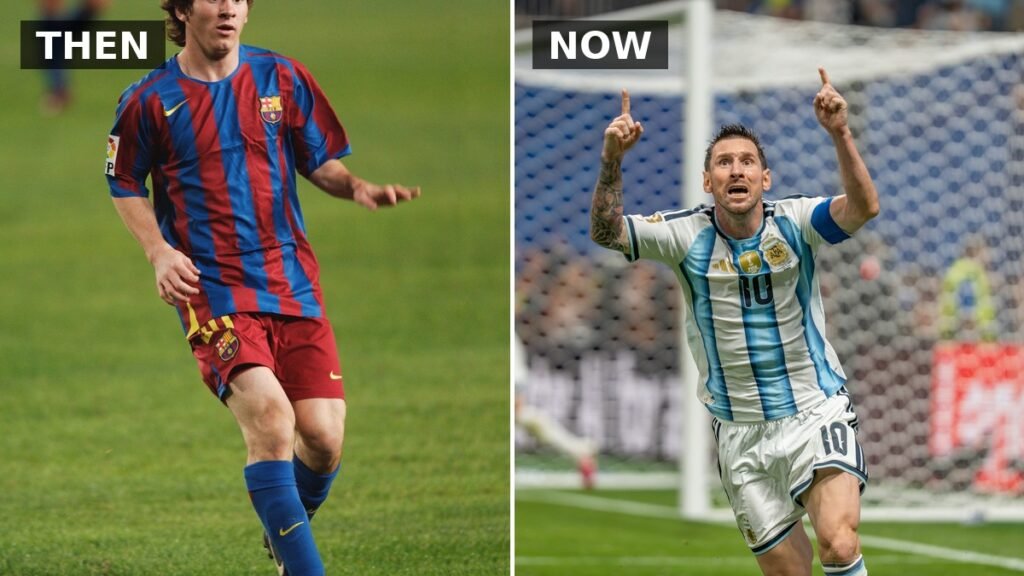
From a 47-second debut in Budapest to one last night at the Monumental
From a 47-second debut in Budapest to one last night at the Monumental: how a boy formed in Barcelona became Argentina’s record scorer, a World Cup winner at 35, and the player a nation of 85,000 said goodbye to on Tuesday night. Messi’s Argentina career ended the way it deserved to: on the pitch, with a goal, two assists, a 3-0 win — and the whole stadium standing one last time.
The farewell, in one line: Argentina 3-0 Benin, international friendly, Estadio Más Monumental, Buenos Aires, Tuesday 6 October 2026. Messi: 90 minutes, two assists, one goal, man of the match. Final Argentina tally: 208 caps, 126 goals, 69 assists.
Then: a debut that lasted 47 seconds
Every Then & Now story needs a starting point that feels impossibly far from the ending. For Messi and Argentina, it is 17 August 2005, a friendly against Hungary in Budapest. The 18-year-old, already a sensation at Barcelona, came off the bench to replace Lisandro López — and was sent off 47 seconds later, shown a red card for an elbow as he tried to shake off a defender tugging his shirt. His senior international career began with him walking down the tunnel in tears.
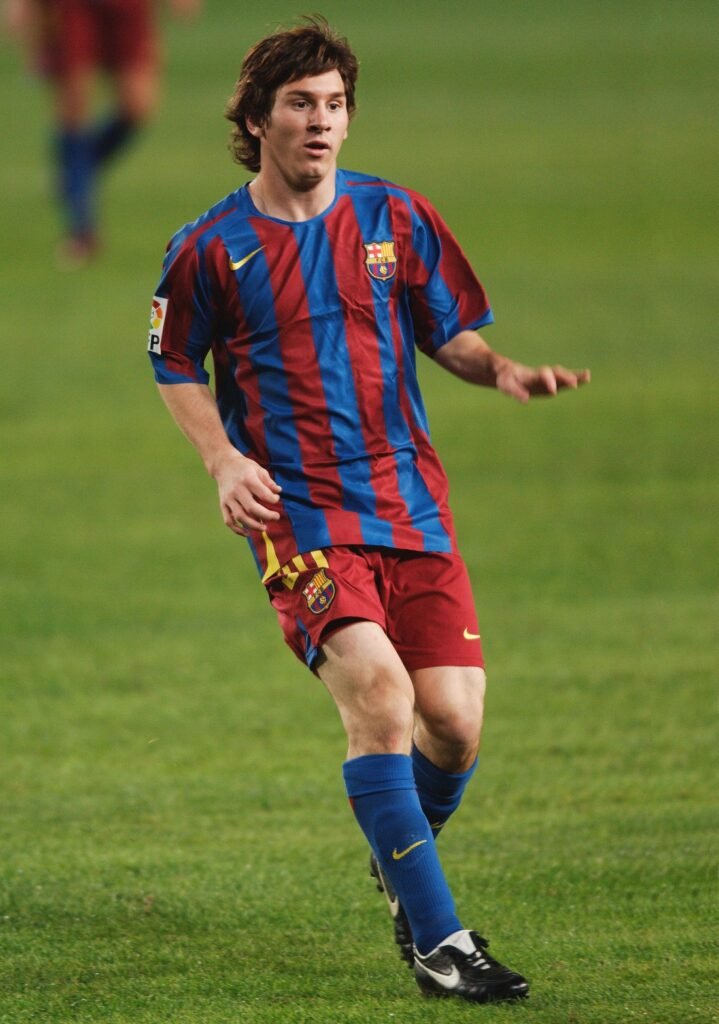
It would be wrong to call that night a false start. Less than a year later, at the 2006 World Cup in Germany, Messi scored against Serbia and Montenegro on 16 June 2006 — aged 18 years and 358 days, still Argentina’s youngest-ever World Cup scorer. He added Olympic gold in Beijing in 2008. But the debut contained the whole story in miniature: a player Argentina had not raised, formed instead in Barcelona’s La Masia academy after leaving Rosario at 13, whose relationship with his home country would always have to be proved rather than assumed.
That distance mattered. Argentine supporters watched him win everything in Spain while their national team kept falling short. Comparisons with Diego Maradona — who had dragged Argentina to the 1986 World Cup almost alone — followed Messi everywhere. Each tournament that ended without a trophy sharpened the same accusation: magnificent for his club, somehow lesser for his country.
He took the captaincy in 2011 and carried the expectation personally. The near-misses accumulated with a cruelty that began to look like a pattern: the 2007 Copa América final lost to Brazil, then, as captain, the 2014 World Cup final lost to Germany in extra time in Rio, the 2015 Copa América final lost to Chile on penalties, and the 2016 Copa América Centenario final lost to Chile on penalties again — a match in which Messi missed his spot-kick in the shootout.
The night he quit — and the reversal that changed everything
On 26 June 2016, in the tunnel at MetLife Stadium in New Jersey, Messi announced he was done with Argentina. Four finals, four defeats. “For me, the national team is over,” he said. He was 29, at the peak of his powers, and the most gifted Argentine player since Maradona had decided that the shirt cost more than it gave.
Argentina refused to accept it. Fans marched, murals appeared, and the country’s president publicly asked him to reconsider. Within weeks he reversed the decision. That reversal, more than any single match, is the hinge of this whole story: everything Argentina won afterwards — and they won almost everything — happened because their captain agreed to keep failing in public until he didn’t.
The redemption, when it came, arrived in a rush. In July 2021, Argentina beat Brazil 1-0 at the Maracanã to win the Copa América — Messi’s first senior international trophy, at 34. In June 2022 came the Finalissima against Italy at Wembley. Then, in November and December 2022, the tournament that reframed his entire career.
Qatar 2022: the peak
The 2022 World Cup final against France in Lusail is now routinely called the greatest final ever played, and Messi was its central figure. He opened the scoring from the penalty spot, scored again in extra time, and finished the tournament with seven goals and three assists. Argentina led 2-0, were pulled back to 2-2 by a Kylian Mbappé hat-trick, led again through Messi in the 108th minute, were pulled back again, and finally won the shootout 4-2.
Two records from that night still frame his legacy. He became the first player ever to score in the group stage, round of 16, quarter-final, semi-final and final of a single World Cup, and the first player to win the Golden Ball — the tournament’s best-player award — twice, having also won it in defeat in 2014. His eighth Ballon d’Or followed in October 2023. Whatever debate remained about the greatest player of all time effectively ended on 18 December 2022.
The 2022 final in one line: Argentina 3-3 France (4-2 on penalties), Lusail, 18 December 2022. Messi: two goals, including the extra-time strike that made it 3-2. Tournament totals: 7 goals, 3 assists, Golden Ball — at age 35, in his fifth World Cup.
He was not finished. In July 2024, at 37, he captained Argentina to a second straight Copa América title, beating Colombia 1-0 in the final in Miami. The boy who could not win anything with Argentina had, in three years, won everything with them — twice over.
Now: the Miami chapter, and a chosen ending
In July 2023, Messi did the one thing nobody in European football expected: he left. After two Ligue 1 titles with Paris Saint-Germain, he signed for Inter Miami in Major League Soccer, trading the Champions League spotlight for a league still building its global audience — and transformed both the club and the league’s profile almost overnight.
The Miami chapter matters to this Argentina story because it changed the temperature of his late career. Surrounded by former Barcelona teammates, playing in a city with a huge Argentine diaspora, Messi looked like a man enjoying football again rather than enduring it. The results followed: back-to-back league Most Valuable Player honours and, in December 2025, Inter Miami’s first MLS Cup, with Messi setting a playoff record for goal contributions. He arrived at his international farewell not as a fading star being put out to pasture, but as a 39-year-old still deciding matches.
That form carried into his final World Cup this summer. At 39, in his sixth World Cup, Messi scored eight goals — including a hat-trick in the opening match against Algeria — and drove Argentina to a second consecutive final. They lost it 1-0 to Spain in extra time in New Jersey, and Messi took home the Silver Ball. It was a defeat, but a fundamentally different kind from 2014’s: he walked away from this one as a champion defending a legacy, not a genius still chasing one.
His retirement announcement came on 31 August, weeks after the death of his father Jorge — his lifelong manager and closest adviser — had, by his own account, made the decision final. The farewell friendly was the epilogue he chose for himself: one more night at home, on his own terms.
One last night at the Monumental: 3-0, a goal and two assists
The script could not have been written better. Argentina dominated from the start, and the first half had its defining moment in the 10th minute, when the match was briefly halted so a sold-out Monumental — players of both sides included — could give Messi a standing ovation, beneath a giant No. 10 jersey displayed at midfield. It took a while for the intensity to return; Benin, ranked 93rd in the world, defended stoutly and kept the first half goalless despite Messi taking four shots.
The second half was his. In the 48th minute Messi curled in the assist for Nicolás Otamendi’s opener — a fitting combination of two players making their final Argentina appearances, with Otamendi substituted to his own ovation minutes later. In the 61st minute Messi set up Nico Paz for the second. And in the 71st, after Agustín Giay was fouled in the box, Messi converted the penalty for 3-0: his 126th and final international goal.
He played the full 90 minutes, and after the final whistle a drone light show lit up the Buenos Aires sky as the crowd serenaded him with one last “Messi, Messi, Messi” chant. In his address to the supporters, Messi remembered his late father first: it had been, he said, “a huge honor to defend this jersey for over 20 years. Even in the worst of times, I never stopped fighting or giving my all or wanting to be here.”
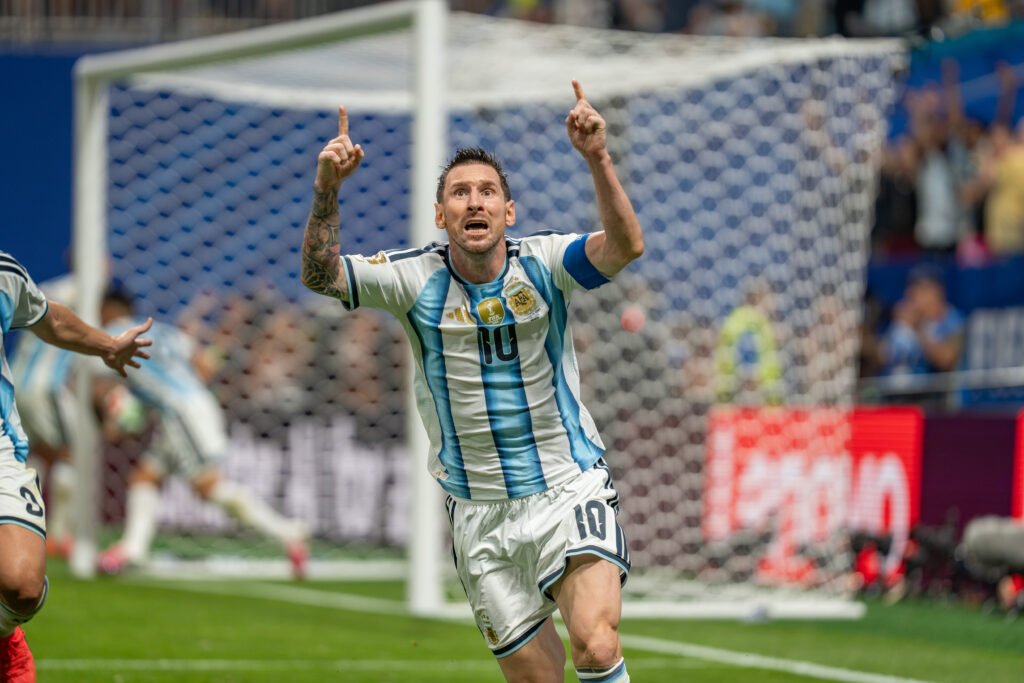
“To play for the Argentina national team is the most beautiful thing that can happen to someone.”
By the numbers: a record book with no successor in sight
| Measure | Messi | Context |
|---|---|---|
| Argentina appearances | 208 | National record; 60 clear of Javier Mascherano |
| Argentina goals | 126 | National record; Gabriel Batistuta is next with 56 |
| Argentina assists | 69 | National record |
| World Cup tournaments | 6 (2006–2026) | Three finals: 2014, 2022, 2026 |
| World Cup goals | 21 | Second only to Kylian Mbappé (22) in tournament history |
| World Cup assists | 12 | All-time World Cup record |
| Major titles with Argentina | 4 | Copa América 2021 and 2024, Finalissima 2022, World Cup 2022 (plus Olympic gold, 2008) |
| Ballon d’Or awards | 8 | All-time record; no other player has more than five |
Read the goals row again. Messi scored 126 times for Argentina; the man in second place, Gabriel Batistuta, scored 56. The gap between first and second on his own country’s list is bigger than most strikers’ entire international careers. His 208 appearances put him second in men’s international history only to Cristiano Ronaldo. These are not records a successor breaks; they are records a successor orbits.
What happens next
Argentina, from 2027, rebuild without their captain for the first time in two decades, with the No. 10 passing to a new player and a young core already introduced by Scaloni across this autumn’s friendlies. Messi returns to Florida, where his Inter Miami contract and the club’s ambitions continue. Twenty-one years, 208 matches, 126 goals, one World Cup, two Copa Américas. The tango ended where it was always going to have to: at home, in front of his people, with nothing left to prove.
Sources and further reading: NBC Sports (farewell match guide, October 2026); MLS Soccer (“Lionel Messi goes out a legend in Argentina farewell”, October 2026); theScore (live updates, October 2026); Sportradar (match result, October 2026); ESPN (squad announcement, October 2026); The New York Times (retirement announcement, September 2026); AP (World Cup final, July 2026). Statistics cross-checked across at least two sources as of 7 October 2026.