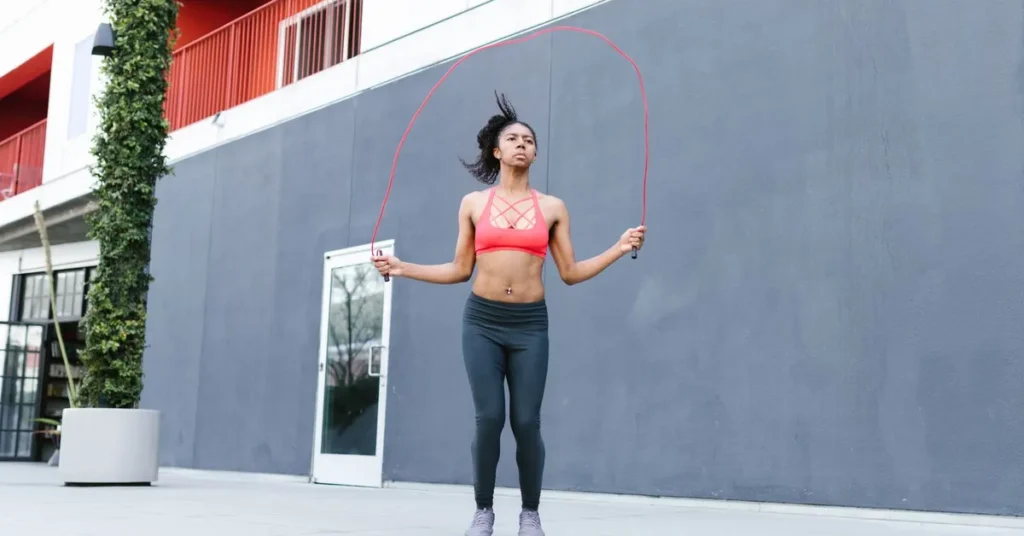
A jump rope is a rope you turn with your hands and jump over — two handles, one cord, and a rhythm you build one skip at a time.
It is NOT a battle rope, which is a thick anchored rope you slam in waves with both hands. A jump rope turns in a full circle over your head; a battle rope never leaves the floor.
It is NOT a resistance band, which is an elastic loop that pulls back as you stretch it. A jump rope adds no resistance — it sets the rhythm, and your legs do the work.
It is NOT a dip belt, which hangs plates from the waist for dips, and it is NOT a weightlifting belt, which braces the waist for squats and deadlifts. A rope is cardio you hold, not load you wear.
It is NOT a lifting strap, which wraps the wrist and the bar to help the grip on pulls, and it is NOT a backpack, which carries cargo on the back. A rope fits in a drawer; a backpack needs a hook.
This guide follows our previous guide, Best Weighted Vests for Home Gyms (2026) — a vest loads the torso for walking and bodyweight work, while a jump rope loads the legs and the heart in short, sharp bursts.
The six picks below run from a 9′3″ swivel rope to a 12 ft competition cable, with four rope types and handle lengths from 5″ to 6.75″. Each one states its own cable, handles and honest limits.
Every photo in this guide is an honest gym or outdoor scene, not a product shot. None of the people shown is holding the named pick — the captions say what each photo actually shows.
One safety note before the picks: this guide is general information only. A jump rope does not treat or cure knee pain, ankle pain, shin pain or any joint condition, and it is not a substitute for medical advice.
If you have persistent pain, numbness, weakness, or a recent injury, talk to a clinician first — and never train through sharp pain to test a rope.
A rope that catches your toes every third skip is sized wrong or timed wrong — shorten it, slow down, and reassess. And a rope that slaps the floor hard is too long, whatever the chart says.
⚡ Quick Picks
Six jump ropes at a glance — a fast Rogue, a competition RPM, a swivel Buddy Lee, a boxing Survival and Cross, a weighted Valeo and a beaded Elevate.
A jump rope is the smallest cardio in this series — it hangs on a hook beside the belt in our dip belts guide, and the two together cover skipping and loaded dips in one corner of a room.
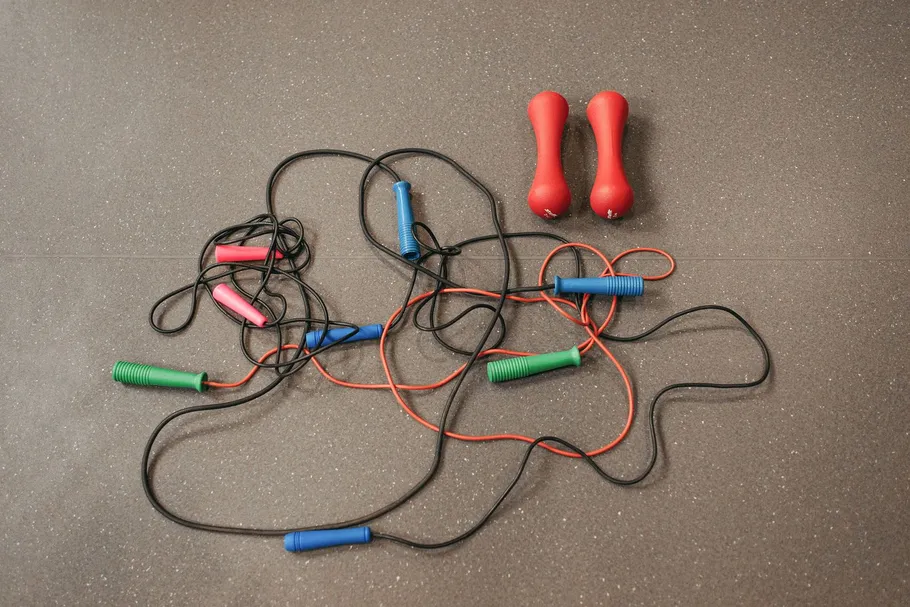
Photo: Pavel Danilyuk, Pexels — Tangled jump ropes and red dumbbells on a gym floor, an honest gym scene, not a product shot.
- Rogue SR-2 Speed Rope 3.0 — Best Speed: the speed pick, a 120″ coated 3/32″ cable on 6.75″ handles; cut-to-fit, made in USA.
- RPM Comp 4.0 — Best Competition: the competition pick, a 12 ft bare cable with dual-axis rotation; coated cables sold separately.
- Buddy Lee Aero Speed — Best Swivel: the swivel pick, a patented swivel bearing on 6.5″ aluminium handles; 9′3″ coated cable.
- Survival and Cross Speed Jump Rope — Best Boxing: the boxing pick, a 10 ft TPU-coated wire on ~5″ handles; fully adjustable.
- Valeo 2-Pound Weighted Solid Rubber — Best Weighted: the weighted pick, a 10 ft solid rubber rope with 1 lb weights in each handle; 2.5 lb total.
- Elevate Rope Professional Beaded — Best Beaded: the beaded pick, a 3 m beaded polycord rope on 5″ handles; 0.1 kg total.
1️⃣ Rogue SR-2 Speed Rope 3.0 — Best Speed

Photo: Yunus Emre Ilıca, Pexels — A young man jumping rope outdoors against a modern sculpture, an honest outdoor scene, not a product shot.
Specs: 6.75″ handles; 120″ (10 ft) coated 3/32″ speed cable; precision ball-bearing swivel; cut-to-fit; made in USA; 0.35 lb frame.
The Rogue is the speed pick: a coated 3/32″ cable on long 6.75″ handles, built to turn fast and stay straight at speed.
The honest limit is the weight figure. The 0.35 lb is the FRAME only, per Gear Patrol — not the whole rope — so do not compare it with the Valeo’s 2.5 lb total or the Elevate’s 0.1 kg total.
Cut the cable to fit, then check the length twice — a cable cut short cannot be lengthened, and a long cable slaps the floor.
The short-handle SR-2S 3.0 is a different listing — 5.25″ handles, the same 120″ cable — so buy the SR-2 for the 6.75″ handles here.
Pros:
- Longest stated handles here at 6.75″ — easy to grip at speed.
- Coated 3/32″ cable turns fast and stays straight.
- Cut-to-fit cable suits tall and short jumpers alike.
Cons:
- The 0.35 lb figure is the frame only — not the whole rope.
- Cutting the cable is permanent — measure twice before you cut.
- Coated cable wears fast on rough concrete.
Who it’s for: speed skippers and CrossFit-style trainers who want a fast coated cable and long handles.
⚠️ The 0.35 lb is the frame only: Gear Patrol’s figure is the frame weight, not the whole rope. Do not rank this rope against the Valeo’s 2.5 lb total or the Elevate’s 0.1 kg total.
Separately, the 6.75″ handles are the longest stated here — the Buddy Lee is second at 6.5″ — and the coated cable is the fastest-feeling type in this guide, though speed itself is not measured.
👉 Check Rogue SR-2 Speed Rope 3.0 on Amazon
2️⃣ RPM Comp 4.0 — Best Competition
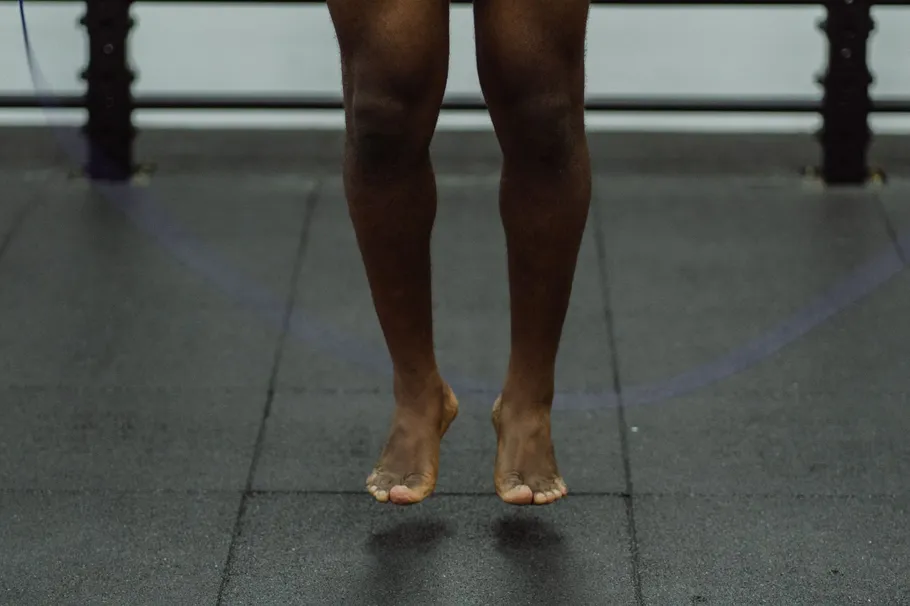
Photo: Ketut Subiyanto, Pexels — Bare feet mid-jump on a dark gym floor, the blue cable arcing low; legs and feet in frame, torso cut at the top — an honest gym scene, not a product shot.
Specs: dual-axis rotation system, dual ball bearings; 12 ft bare cable (fits users up to 7 ft tall); thicker knurling than the Session; coated cables sold separately; 5-year handle warranty; microfiber bag, hex key and spare set screw included.
The RPM is the competition pick: a bare 12 ft cable on a dual-axis swivel, built for double-unders and fast feet.
The honest limit is the surface. A bare cable is fast on a mat and brutal on concrete — the coating is sold separately, and the cable wears fast on rough ground.
The Session is the everyday coated version and the Sprint is the lightest plastic-handled version — both different listings, so buy the Comp for the bare cable here.
Thicker knurling than the Session keeps the handles steady when the hands sweat, and the 5-year handle warranty is the longest stated here.
Pros:
- Longest stated cable here at 12 ft — fits users up to 7 ft tall.
- Dual-axis rotation and dual ball bearings turn smoothly.
- 5-year handle warranty, the longest stated here.
Cons:
- Bare cable wears fast on concrete — use a mat.
- Coated cables sold separately — none in the box.
- Handle length is not stated — check before ordering.
Who it’s for: competition skippers and double-under trainers who want a bare cable and a long reach.
⚠️ The bare cable is not for concrete: a bare steel cable frays fast on rough ground. Jump on a mat or smooth floor, or buy a coated cable separately.
Separately, the 12 ft cable is the longest stated here — the Buddy Lee is the shortest at 9′3″ — and the bag, hex key and spare set screw are the most complete kit in this guide.
👉 Check RPM Comp 4.0 on Amazon
3️⃣ Buddy Lee Aero Speed — Best Swivel
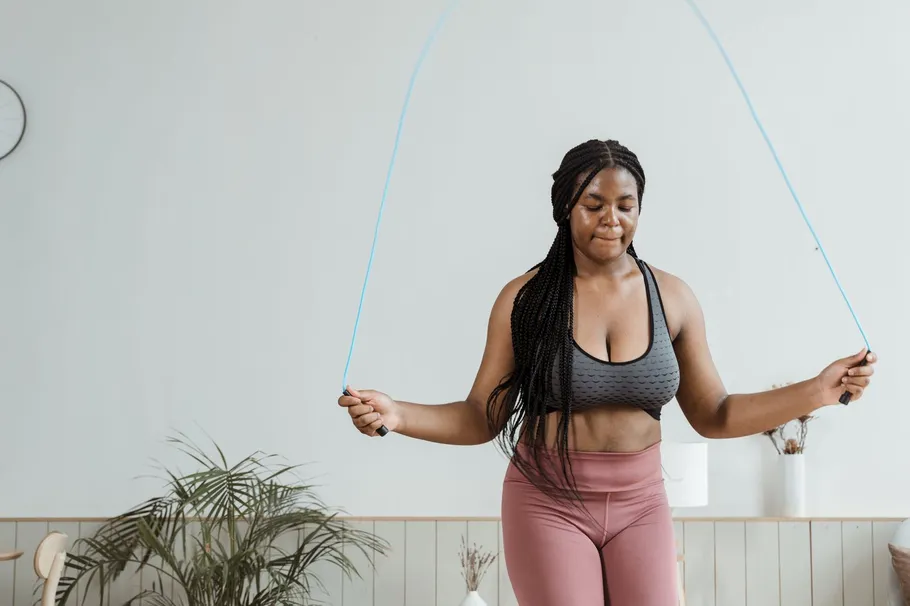
Photo: MART PRODUCTION, Pexels — A woman jumping rope at home, the blue rope arcing overhead — legs cut below the knees, an honest home scene, not a product shot.
Specs: 6.5″ T-Grade aluminium handles; soft neoprene grips; patented swivel bearing; adjustable 9′3″ PVC-coated stainless steel cable.
The Buddy Lee is the swivel pick: a patented swivel bearing that keeps the cable turning true, on soft neoprene grips.
The honest limit is the listing. The handle is 6.5″ per the maker listing but 6″ per the Amazon title, and the cable is 9′3″ per the maker but 9′4″ per one roundup — the maker listing is the authority.
The handle material is stated two ways too — aluminium per the maker listing, polycarbonate per one roundup — and this guide prints both, with the maker listing as the authority.
USA Wrestling named Buddy Lee Jump Ropes an Official Jump Rope Partner on 30 September 2026 — the only pick here with a federation link.
Pros:
- Patented swivel bearing keeps the cable turning true.
- Soft neoprene grips stay comfortable on long sets.
- Second-longest stated handles here at 6.5″.
Cons:
- Handle length differs between listings — 6.5″ or 6″.
- Cable length differs between sources — 9′3″ or 9′4″.
- Handle material is stated two ways — aluminium or polycarbonate.
Who it’s for: rhythm skippers and boxers who want a smooth swivel and a soft grip.
⚠️ Check the listing before ordering: the handle length, cable length and handle material are all stated two ways across sources. The maker listing is the authority — read it, not the roundup.
Separately, the 9′3″ cable is the shortest stated here — the RPM is the longest at 12 ft — and the swivel bearing is the feature that earns this pick its place.
👉 Check Buddy Lee Aero Speed on Amazon
4️⃣ Survival and Cross Speed Jump Rope — Best Boxing
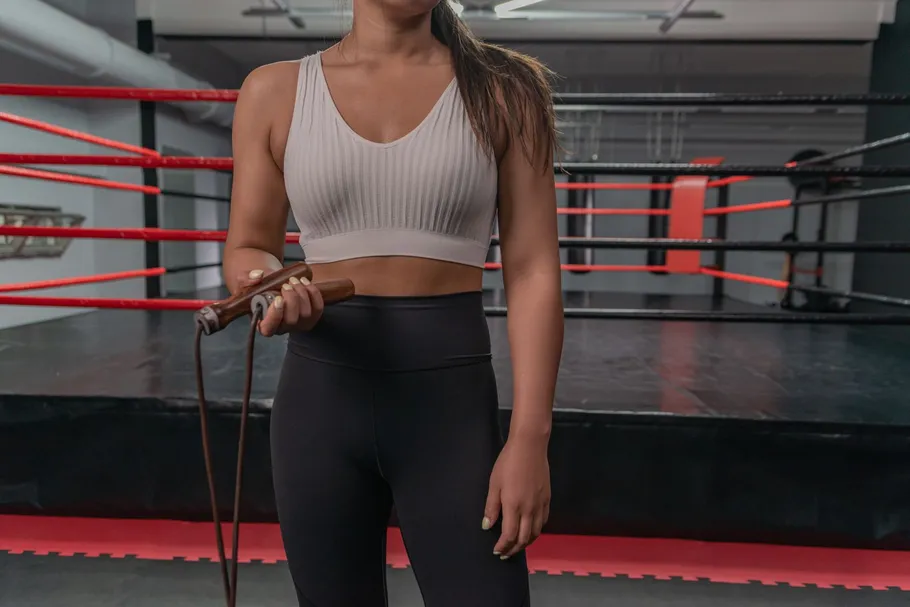
Photo: Yaroslav Shuraev, Pexels — A woman holding a wooden-handled rope in a boxing gym, the ring behind her — head cut at the top of the frame, an honest gym scene, not a product shot.
Specs: 10 ft TPU-coated wire; dual ball-bearing ~5″ handles; urethane grips; nickel-plated brass cable stoppers; fully adjustable (sliding screws and collars, cut the excess); Amazon ASIN B00LGXE5NS.
The Survival and Cross is the boxing pick: a TPU-coated wire on ball-bearing handles, built for rounds on the gym floor.
The honest limit is the adjustment. The rope is fully adjustable with sliding screws and collars — but the excess must be cut, or it whips at speed.
Nickel-plated brass stoppers hold the cable in the handles, and the urethane grips stay steady when the hands sweat.
Boxers skip between rounds, not for show — a rope that turns true for three minutes, round after round, is the job here.
Pros:
- TPU-coated wire turns fast and resists kinks.
- Dual ball bearings keep the spin smooth.
- Fully adjustable — sliding screws and collars.
Cons:
- Excess cable must be cut — or it whips.
- Handle length is approximate at ~5″ — not exact.
- Coated wire still wears on rough concrete.
Who it’s for: boxers and fight-gym trainers who want a tough coated wire for rounds.
⚠️ Cut the excess after adjusting: the sliding screws and collars set the length, but the tail must be cut. A long tail whips the legs at speed.
Separately, the ~5″ handles tie with the Elevate for the shortest stated here — the Rogue is the longest at 6.75″ — and the brass stoppers hold the cable in the handles.
👉 Check Survival and Cross Speed Jump Rope on Amazon
5️⃣ Valeo 2-Pound Weighted Solid Rubber — Best Weighted
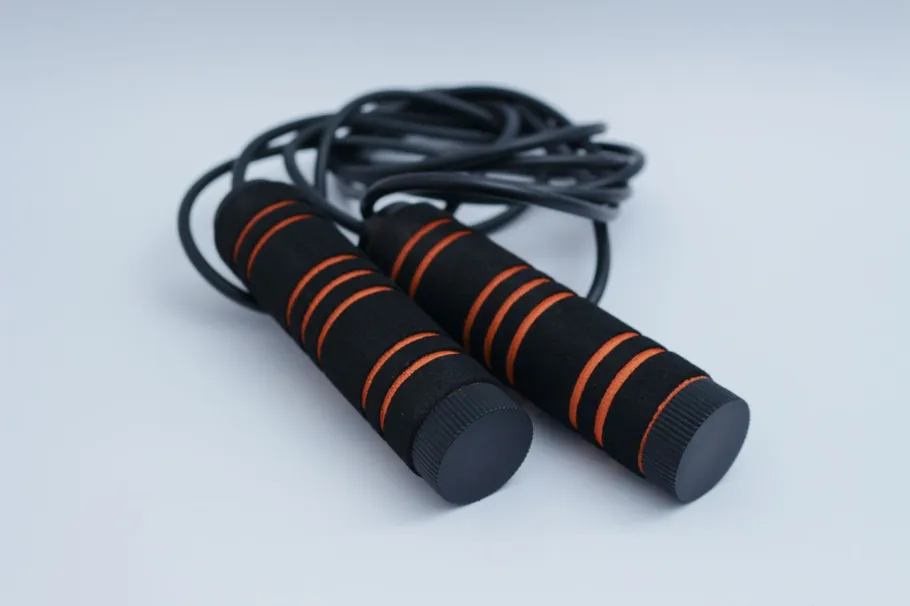
Photo: Dom J, Pexels — Black foam handles with orange stripes and a coiled black cord on white, an honest still life, not a product shot.
Specs: adjustable 10 ft solid rubber rope; cushioned foam handles; removable 1 lb weights in each handle (2 lb total); sealed ball bearings; item weight 2.5 lb; Amazon ASIN B000BKXE0C.
The Valeo is the weighted pick: a solid rubber rope with 1 lb weights in each handle, built to load the arms and shoulders as you skip.
The honest limit is the weight. The 2.5 lb item weight is the heaviest stated TOTAL here — heavier than the Elevate’s 0.1 kg — so start slow and keep the first sets short.
The weights come out of the handles, so the rope drops to its unweighted feel when the arms tire — a useful reset mid-workout.
Solid rubber is one of the slowest rope types here by design — it trades speed for load, and that trade is the point.
Pros:
- Heaviest stated total here at 2.5 lb — real load on the arms.
- Weights come out — two ropes in one.
- Cushioned foam handles stay comfortable under load.
Cons:
- Slow rope type — not a speed rope.
- Solid rubber wears on rough concrete.
- Handle length is not stated — check before ordering.
Who it’s for: lifters and trainers who want load on the arms, not speed on the clock.
⚠️ The 2.5 lb is the whole rope: the item weight is the heaviest stated total here. Start with short sets — weighted skipping loads the shoulders fast.
Separately, the foam handles in the photo match the cushioned foam handles on the listing — padding that suits the extra weight. And the sealed ball bearings keep the spin smooth under the extra weight.
👉 Check Valeo 2-Pound Weighted Solid Rubber on Amazon
6️⃣ Elevate Rope Professional Beaded — Best Beaded

Photo: Anna Shvets, Pexels — An older man with a jump rope on a stadium track — head cut at the top of the frame, an honest outdoor scene, not a product shot.
Specs: 3 m adjustable (up to 10 ft); 5 mm polycord with beads; 5″ handles; 0.1 kg; Amazon ASIN B0C6HC58WV.
The Elevate is the beaded pick: a 5 mm polycord rope with beads, built for rhythm — the beads click the timing so the feet learn the beat.
The honest limit is the speed. A beaded rope trades speed for feedback by design — it is one of the slowest rope types here, and that is the point, not a flaw.
At 0.1 kg, this is the lightest stated TOTAL here — lighter than the Valeo’s 2.5 lb — so the arms stay fresh while the feet learn.
The 5 mm cord is the thickest stated diameter here — the Rogue’s 3/32″ is the thinnest stated — and the beads make the rope easy to see in the air.
Pros:
- Lightest stated total here at 0.1 kg.
- Beads give rhythm feedback the feet can follow.
- Thickest stated cord here at 5 mm — easy to see.
Cons:
- Slow rope type — not for speed work.
- Beads can sting the shins on a mistimed skip.
- 3 m needs trimming for shorter jumpers.
Who it’s for: beginners and rhythm learners who want to hear and see the timing.
⚠️ Beads trade speed for rhythm: this rope is one of the slowest types here by design. Buy it to learn the beat, not to chase a personal best.
Separately, the 5″ handles tie with the Survival and Cross for the shortest stated here — the Rogue is the longest at 6.75″ — and the 3 m length adjusts up to 10 ft, so tall jumpers fit too.
👉 Check Elevate Rope Professional Beaded on Amazon
📊 Comparison Table
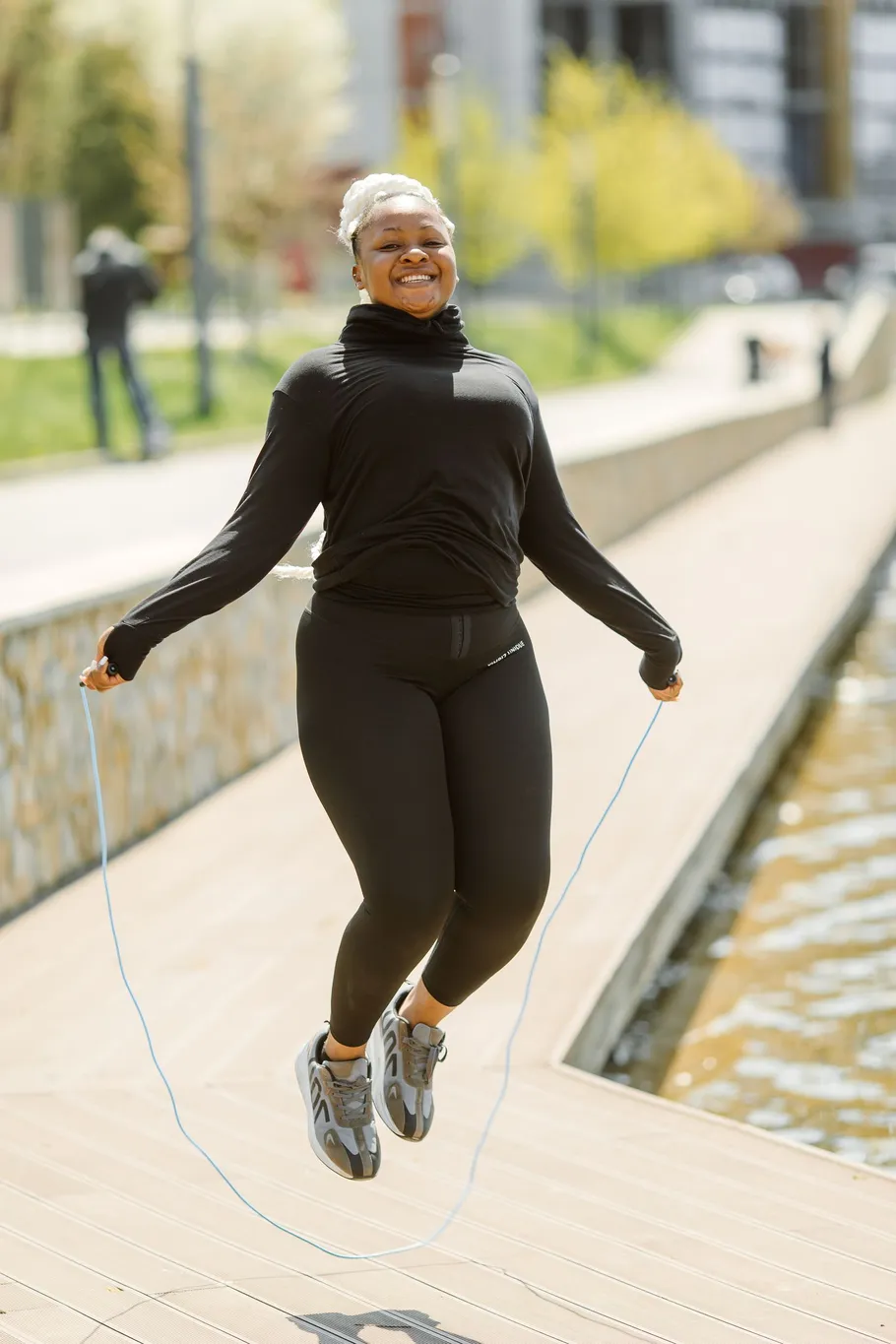
Photo: Gustavo Fring, Pexels — A woman jumping rope outdoors on a sunny day by the water, an honest outdoor scene, not a product shot.
| Pick | Rope type | Cable length | Handles | Watch out |
| Rogue SR-2 Speed Rope 3.0 | Coated speed cable | 120″ (10 ft) | 6.75″ | Cut-to-fit — measure twice |
| RPM Comp 4.0 | Bare speed cable | 12 ft | Not stated | Bare cable wears fast on concrete |
| Buddy Lee Aero Speed | Coated speed cable | 9′3″ | 6.5″ (6″ per Amazon title) | Handle and cable figures differ by source |
| Survival and Cross Speed Jump Rope | Coated wire (TPU) | 10 ft | ~5″ | Cut the excess after adjusting |
| Valeo 2-Pound Weighted | Weighted solid rubber | 10 ft | Not stated | 2.5 lb total — start slow |
| Elevate Professional Beaded | Beaded polycord | 3 m (up to 10 ft) | 5″ | Beads trade speed for rhythm |
Table honesty note: the Rope type column mixes four types — coated speed cables (Rogue, Buddy Lee, Survival and Cross), a bare speed cable (RPM), weighted solid rubber (Valeo) and beaded polycord (Elevate) — so do not rank the six by the Rope type column alone.
The Cable length column runs 9′3″ to 12 ft and covers all six picks, since every pick states a length — the Buddy Lee is the shortest stated at 9′3″ and the RPM the longest stated at 12 ft.
The Handles column mixes stated lengths with unstated ones — the Rogue is the longest stated at 6.75″, the Elevate and the Survival and Cross tie for the shortest stated at 5″ and ~5″, and the RPM and the Valeo state no handle length at all.
Weight figures are not comparable across picks: the Valeo’s 2.5 lb is the heaviest stated TOTAL, the Elevate’s 0.1 kg is the lightest stated TOTAL, and the Rogue’s 0.35 lb is the FRAME only — so do not rank the six by weight.
Cable diameter is stated for two picks only — the Elevate at 5 mm is the thickest stated and the Rogue at 3/32″ is the thinnest stated — so do not rank the six by diameter.
Do not crown any pick the fastest in this guide without the qualifier: speed is not measured here, the beaded Elevate trades speed for rhythm by design, and the weighted Valeo trades speed for load.
The same-variant conflicts are printed, not settled: the Buddy Lee handle is 6.5″ per the maker listing but 6″ per the Amazon title, its cable is 9′3″ per the maker but 9′4″ per one roundup, and its handle material is aluminium per the maker but polycarbonate per one roundup.
All six picks are adjustable — every rope here can be sized to the jumper — and the table’s “Watch out” column carries listing and fit notes, not a verdict.
🧭 How to Choose the Right Jump Rope

Photo: Anastasia Shuraeva, Pexels — Two adults with jump ropes outdoors, mountains behind — both fully in frame, an honest outdoor scene, not a product shot.
Start with the type. A coated speed cable turns fast, a bare cable turns fast on a mat, a weighted rubber rope loads the arms, and a beaded rope teaches the rhythm.
A coated cable suits buyers who want speed without fuss. A bare cable suits buyers who compete, and a beaded rope suits buyers who are still learning the beat.
None of these is a battle rope, a resistance band, a dip belt or a weightlifting belt. If it stays on the floor, stretches, hangs plates or braces the waist, it is not a jump rope, whatever the listing title says.
Then pick the size and fit. Stand on the middle of the rope and pull the handles up — they should reach your armpits, no higher and no lower.
The RPM is the longest stated cable here at 12 ft and the Buddy Lee the shortest at 9′3″, while the Rogue has the longest stated handles at 6.75″ — so measure first and buy long, then cut down.
A rope that is too long slaps the floor and tangles; a rope that is too short catches the toes. Buy long and cut down — a cable cut short cannot be lengthened.
Think about the cable next. Bare cable is fast and fragile on concrete, coated cable is fast and tougher, beaded cord is slow and visible, and solid rubber is slow and heavy.
A bare cable needs a mat or a smooth floor — concrete frays it in weeks. A coated cable lasts longer on rough ground, and a beaded rope holds up well on pavement.
Check the handles before you buy. Long handles suit big hands and fast turning, short handles suit small hands and tight spaces, and foam grips suit long sets.
And check the ground, not the listing headline. A mat protects the cable and the knees, a smooth floor suits speed, and rough concrete eats every cable type — start on a mat.
Think about care. Coil the rope loosely, wipe the handles after sweaty sets, and store it hung or coiled — never knotted hard. A rope left tangled in a bag kinks, and a kinked cable never turns true.
A jump rope is cardio, not a brace — our weightlifting belts guide covers the stiff band for the waist itself, so the core is covered in two pieces.
Finally, kit out the rest of the session honestly. A rope warms the body up and cools it down, and the strength work that makes skipping useful still needs the basics, which is why our adjustable dumbbells guide sits alongside this one in a home gym.
❓ Frequently Asked Questions
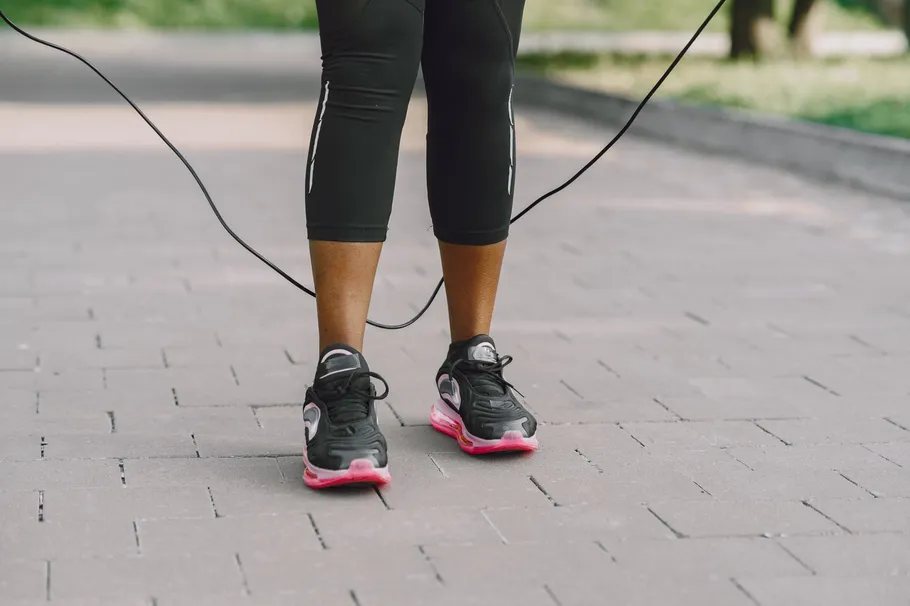
Photo: Gustavo Fring, Pexels — Lower legs and sneakers mid-jump on outdoor pavement, the black cable low — an honest outdoor scene, not a product shot.
Will a jump rope help me lose weight or fix my knees?
No. A jump rope is cardio — it raises the heart rate and works the legs — but it does not treat or cure knee pain, ankle pain, shin pain or any joint condition, and no pick in this guide claims otherwise.
A rope lets you skip in short bursts, so the heart and legs work harder — but that help is for the workout, not a promise about weight or pain, and a rope is not a treatment.
Persistent pain, numbness, weakness, or a recent injury belongs with a clinician first — a rope is not a diagnosis, and training through sharp pain to test one is a bad idea.
How long should my jump rope be?
Armpit height is the test. Stand on the middle of the rope and pull the handles up — if they reach your armpits, the length is right, and if they pass your shoulders, the rope is too long.
Buy long and cut down. The RPM is 12 ft, the Buddy Lee is 9′3″, and every pick here is adjustable — so order the long one and trim it to fit.
Can I jump rope on concrete?
Yes, but the cable pays for it. A bare cable frays fast on concrete, a coated cable lasts longer, and a beaded rope holds up well on pavement.
Use a mat when you can. A mat protects the cable and the knees, and a smooth floor suits speed better than rough concrete.
How often should I replace a jump rope?
When the cable frays, kinks or stops turning true. A coated cable on a mat lasts months of regular skipping; a bare cable on concrete can fray in weeks.
Check the cable before every session. A frayed cable snaps without warning, and a snapped cable at speed stings.
Are weighted jump ropes better than speed ropes?
They do different jobs. A weighted rope like the Valeo loads the arms and shoulders; a speed rope like the Rogue turns fast for double-unders.
Choose the weighted rope for load and the speed rope for speed. Neither one is better — the job decides, not the rope.
What should I do after a jump rope workout?
Cool down slowly. Walk for a few minutes, stretch the calves gently, and let the heart rate come down before you sit.
Keep the legs loose between sessions, since our foam rollers guide covers the recovery side of a home-gym routine.
Thanks for reading — we hope this guide helps you pick a jump rope that turns true and does the job you actually need. If a length or a handle size disagrees with what you measured, trust the listing, not the headline.
Disclosure: As an Amazon Associate, we earn from qualifying purchases made through links in this article, at no extra cost to you. Product details and availability can change, so please check the listing before ordering.
Pingback: Best Massage Guns for Home Gyms (2026)