A weighted vest is a vest that spreads added load across the chest and back, so walking, rucking, push-ups, squats and pull-ups can be loaded without holding a dumbbell or hanging plates from the waist.
It is NOT a dip belt, which is a padded belt that hangs plates from the waist for dips. A weighted vest spreads the load across the torso for walking and bodyweight work; a dip belt hangs plates from the waist for the dip.
It is NOT a weightlifting belt, which is a stiff band that braces the waist for squats and deadlifts. A vest adds load to the torso; a weightlifting belt braces the waist itself.
It is NOT a lifting strap, which is a loop that wraps the wrist and the bar to help the grip on pulls, and it is NOT a backpack or rucksack, which carries cargo on the back with a hip belt.
This guide follows our previous guide, Best Dip Belts for Home Gyms — a dip belt hangs plates from the waist for dips, while a weighted vest spreads load across the torso for walking, rucking and bodyweight work. Many home-gym lifters look at both before deciding which load fits their training.
The six picks below run from an 11 lb value vest to a 300 lb heavy-duty rig, with stated maximums from 20 lb to 300 lb across five picks. Each one states its own load system, capacity and material honestly, including the lookalikes you should not buy past.
Every photo in this guide is an honest gym or outdoor scene, not a product shot. None of the people shown is wearing the named pick — the captions say what each photo actually shows.
One safety note before the picks: this guide is general information only. A vest does not treat or cure back pain, shoulder pain, knee pain or any joint condition, and it is not a substitute for medical advice.
If you have persistent pain, numbness, weakness, or a recent injury, talk to a clinician first — and never train through sharp pain to test a vest.
A vest that pinches, numbs, or leaves marks that do not fade quickly fits wrong or hangs wrong — adjust it and reassess. And a vest that bounces on every step is loaded wrong, whatever the chart says.
⚡ Quick Picks
Six weighted vests at a glance — a tough 5.11 plate carrier, a snug Hyperwear, a heavy-duty Kensui, a value VEVOR, a rucking GORUCK and an over-shoulder Titan.
If your training needs grip help rather than a loaded torso, a glove does a different job — grip and padding for the hands, not weight on the chest — and our MMA gloves guide covers that half of the kit.
Photo: Fernando Capetillo, Pexels — A man in a tank top doing push-ups in a modern gym, an honest gym scene, not a product shot.
- 5.11 TacTec Plate Carrier — Best Plate Carrier: the plate-carrier pick, tough 500D nylon that takes 5.11 or Rogue plates; plates sold separately.
- Hyperwear Hyper Vest PRO — Best Fitted: the fitted pick, pre-loaded at 10 lb with steel micro-weights; max varies by size.
- Kensui EZ-VEST V2 — Best Heavy-Duty: the heavy-duty pick, a frame that holds your own Olympic plates up to a stated 300 lb (Max version); plates not included.
- VEVOR Adjustable Weighted Vest 11–20 lb — Best Value: the value pick, six 1.5 lb iron pellet bags included; confirm the adjustable model.
- GORUCK Rucking Weight Vest — Best Rucking: the rucking pick, the lightest stated empty vest at 1.5 lb, built for Curved Ruck Plates; plates sold separately.
- Titan Fitness Adjustable Weighted Vest — Best Over-Shoulder: the over-shoulder pick, ingot-loaded in 2.5 lb steps, 20–60 lb by option.
1️⃣ 5.11 TacTec Plate Carrier — Best Plate Carrier
Photo: Dan Galvani Sommavilla, Pexels — A black tactical vest on a mannequin against a dark background, a vest on display, not a product shot of the 5.11 pick.
Specs: 500D nylon; carrier 2.5 lb; sizes S–XL; cummerbund fits 52–57″; plates sold separately; 5.11 plates 5.75 or 8.75 lb each; Rogue USA Cast plates compatible (5, 7.5, 10, 20 lb each).
The 5.11 is the plate-carrier pick: a 500D nylon carrier that takes plates front and back, from the maker’s own page.
The honest limit is the load. The carrier alone weighs 2.5 lb and adds no training load by itself — the plates decide the weight, so a pair of Rogue 20 lb plates plus the 2.5 lb carrier totals 42.5 lb.
Note the TacTec Training Vest is a different variant — 600D polyester, 2.03 lb — so buy the Plate Carrier, not the Training Vest, if you want the 500D nylon carrier here.
This is a fitness accessory only, never body armour — the carrier is for training load, not protection.
Pros:
- Tough 500D nylon, built for plate-carrier training.
- Cummerbund fits a wide waist range at 52–57″.
- Works with 5.11 plates and Rogue USA Cast plates.
- Proven plate-carrier layout, front and back plates.
Cons:
- Plates sold separately — no load in the box.
- No vest maximum is stated — the plates decide.
- S–XL sizing needs a size check before ordering.
Who it’s for: lifters and ruckers who want a plate carrier that takes standard plates and fits over a shirt.
⚠️ Plates are sold separately: the carrier alone weighs 2.5 lb and adds no training load by itself. Budget for plates — a pair of 5.11 plates or Rogue plates — before the first walk.
Separately, the 2.5 lb carrier is the second-lightest stated empty vest here, after the GORUCK at 1.5 lb. And the cummerbund size is the fit check — measure first, since S–XL covers a wide range.
👉 Check 5.11 TacTec Plate Carrier on Amazon
2️⃣ Hyperwear Hyper Vest PRO — Best Fitted

Photo: Gustavo Fring, Pexels — Back view of a woman jogging in activewear on an urban walkway, an honest outdoor scene, not a product shot.
Specs: pre-loaded 10 lb of galvanised steel micro-weights (2.25 oz bars, two per pocket); Xyflex stretch compression fabric; side lacing; slim profile; 5 lb booster boxes sold separately.
The Hyperwear is the fitted pick: the snuggest vest here, with micro-weights that sit close to the body so the vest barely moves on walks and runs.
The honest limit is the size. Capacity varies by size per the maker — S 20 lb, M 25 lb, L 30 lb, XL 40 lb — so the size you wear decides the maximum you can load.
One roundup disagrees: Eleiko’s product sheet lists approx max S 22 lb, M 24 lb, L 34 lb, XL 48 lb. This guide prints both figures, and the maker page is the authority.
Size up at a boundary — a vest that is too tight rides up, and a vest that is too loose bounces.
Pros:
- Closest fit in this guide, with a slim profile under a jacket.
- Micro-weights spread the load evenly across the torso.
- Side lacing adjusts the fit as the load changes.
- Arrives pre-loaded at 10 lb, ready to walk in.
Cons:
- Max load depends on size — check the chart first.
- Booster boxes cost extra on top of the vest.
- Stretch fabric needs care in the wash.
Who it’s for: walkers and runners who want a vest that stays put and disappears under a top.
⚠️ Check your size against the maker’s chart: the max load changes with size, and the two sources disagree on the numbers — S 20 lb per the maker, S 22 lb per Eleiko’s sheet. The maker page is the authority.
Separately, the pre-loaded 10 lb is the lightest loaded start here, and the 5 lb booster boxes are the way up. Add boosters only when 10 lb feels easy on a walk.
👉 Check Hyperwear Hyper Vest PRO on Amazon
3️⃣ Kensui EZ-VEST V2 — Best Heavy-Duty
Photo: Ardit Mbrati, Pexels — A man in a black shirt deadlifting a loaded barbell in a gym, motivational wall text behind him, an honest gym scene, not a product shot.
Specs: three versions Lite 80 lb, Pro 150 lb, Max 300 lb; uses standard 1″/2″ Olympic plates you already own (not included); frame 4 lb; sizes XS–3XL; quick-release buckle (Max); 100-day money-back guarantee.
The Kensui is the heavy-duty pick: a frame that holds your own Olympic plates, so the load grows in 2.5 lb steps as you add plates.
The honest limit is the version. The 300 lb figure is the Max version only — the Lite tops out at 80 lb and the Pro at 150 lb — so confirm the version on the listing.
The material is stated two ways: 1680D ballistic nylon on the Amazon MAX listing, 750D Cordura in one roundup. This guide prints both, and the listing is the authority.
Micro-load in 2.5 lb increments — small plates make small jumps, which is how a heavy vest stays usable.
Pros:
- Highest stated max here at 300 lb (Max version).
- Uses plates you already own — no new weights to buy.
- XS–3XL sizing covers a wide range of lifters.
- 100-day money-back guarantee on the vest.
Cons:
- Plates not included — the vest ships as a frame.
- The frame alone is 4 lb, the heaviest stated frame here.
- The Max version is the only one with the quick-release buckle.
Who it’s for: strong lifters who already own Olympic plates and want the heaviest vest option.
⚠️ The 300 lb figure is the Max version only: the Lite tops out at 80 lb and the Pro at 150 lb, so confirm the version on the listing you open — ordering the Lite by mistake caps you at 80 lb.
Separately, if you own no plates, budget for them — the vest ships as a frame, not a loaded vest. And the frame’s 4 lb counts toward the total load on every walk.
👉 Check Kensui EZ-VEST V2 on Amazon
4️⃣ VEVOR Adjustable Weighted Vest 11–20 lb — Best Value
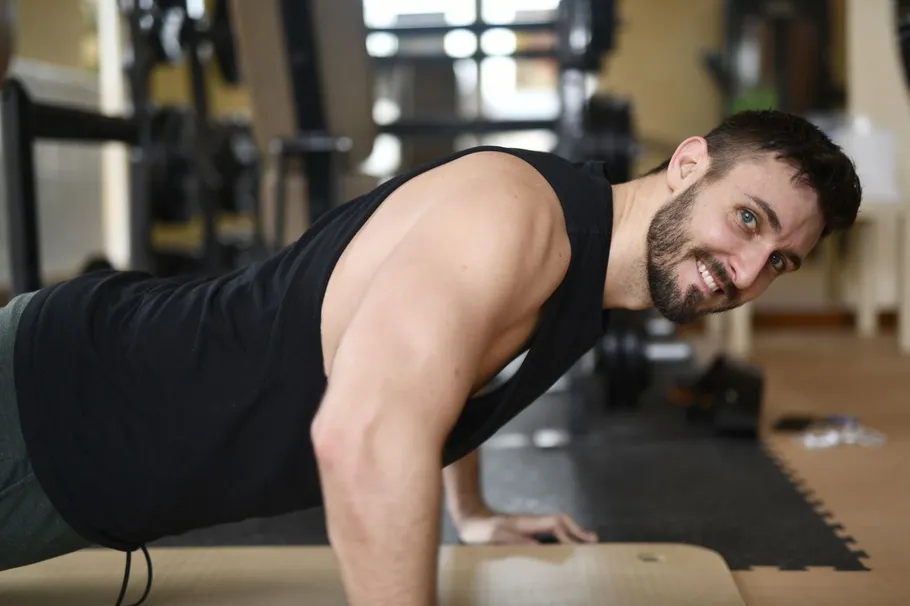
Photo: Andrea Piacquadio, Pexels — A smiling man in a black tank top doing push-ups in a gym, an honest gym scene, not a product shot.
Specs: 6 × 1.5 lb iron pellet bags; neoprene; double-stitch; reflective stripes; adjustable buckle straps; padded shoulders; adjustable model JS-VEST006-1.
The VEVOR is the value pick: the cheapest way into a weighted vest here, with six 1.5 lb bags that load the vest from 11 to 20 lb.
The honest limit is the ceiling. The 20 lb top end is the lowest here — a gentle first vest, not a heavy one — and the 11 lb starting load is a gentle first step.
Reflective stripes help on evening walks, and the padded shoulders spread the load across the traps.
Confirm the adjustable JS-VEST006-1, not the fixed 20 lb JS-VEST005-3 — a different model, with a 35–45″ bust and dual storage pockets.
Pros:
- Lowest stated top end here at 20 lb — easy to start.
- Iron pellet bags included — no separate purchase.
- Reflective stripes for evening walks.
- Padded shoulders spread the load.
Cons:
- 20 lb ceiling is the lowest here — no room to grow past it.
- Neoprene runs warm on long walks.
- Check the model number before ordering.
Who it’s for: beginners and walkers who want a low-cost first vest and a gentle starting load.
⚠️ Confirm the adjustable model: the fixed 20 lb model (JS-VEST005-3) is a different listing with a 35–45″ bust and dual storage pockets. Order the adjustable JS-VEST006-1 for the 11–20 lb range.
Separately, the 11 lb starting load is a gentle first step — only the Hyperwear starts lighter, at 10 lb pre-loaded. Remove bags to go lighter still, and add them back as 11 lb feels easy.
👉 Check VEVOR Adjustable Weighted Vest on Amazon
5️⃣ GORUCK Rucking Weight Vest — Best Rucking

Photo: paolo tognoni, Pexels — A lone hiker with a backpack walking a mountain trail under a clear blue sky, an honest outdoor scene, not a product shot.
Specs: 500D CORDURA exterior, 210D CORDURA interior; 1.5 lb unloaded; Curved Ruck Plates sold separately in pairs (6.25 lb each = 14 lb total, 9.25 lb each = 20 lb total, 14.25 lb each = 30 lb total); panels 11″W × 13″H; sizes S/M and L/XL; front phone/pocket holder.
The GORUCK is the rucking pick: built for rucking, with vest-specific Curved plates that hug the torso.
The honest limit is the plate. The current product name is “Rucking Weight Vest” — not the older “Training Weight Vest 2.0” — and the plates are vest-specific Curved plates, NOT GORUCK’s flat Standard backpack plates.
The 14 lb total with the lightest plates is a sensible first ruck load, and the 30 lb pair is the top end.
At 1.5 lb unloaded, this is the lightest stated empty vest here — lighter than the 5.11 at 2.5 lb and the Kensui frame at 4 lb.
Pros:
- Lightest stated empty vest here at 1.5 lb.
- Curved plates sit close to the body on the ruck.
- Tough 500D CORDURA exterior.
- Front phone pocket keeps a phone in reach.
Cons:
- Plates sold separately — no load in the box.
- Only two size bands, S/M and L/XL.
- Curved plates fit this vest only.
Who it’s for: ruckers who walk with load and want a vest shaped for the job.
⚠️ Buy Curved Ruck Plates, not flat Standard plates: GORUCK’s flat Standard plates are for its backpacks and do not fit this vest. The Curved plates are the ones that fit.
Separately, the panels are 11″ wide by 13″ high, so check the plate size against the panel before ordering. And the S/M and L/XL bands are the only fit choice — measure first.
👉 Check GORUCK Rucking Weight Vest on Amazon
6️⃣ Titan Fitness Adjustable Weighted Vest — Best Over-Shoulder
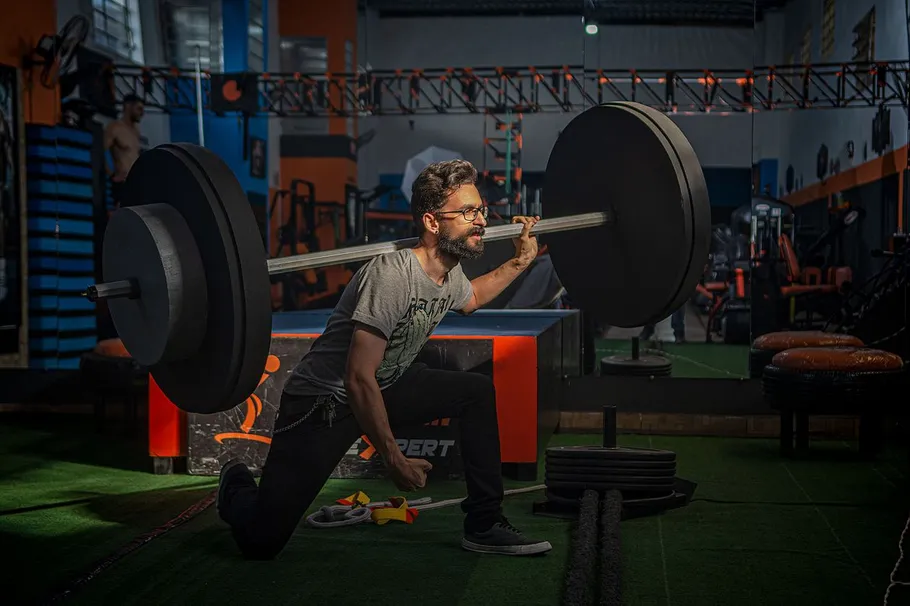
Photo: Joel Santos, Pexels — A bearded man squatting with a barbell in a gym, an honest gym scene, not a product shot.
Specs: 20–60 lb max options; 2.5 lb ingot cast steel weights; 1050D nylon Cordura shell; round shoulder design; foam + rubber interior; Velcro closure with double D-ring inserts; hand wash, remove weights.
The Titan is the over-shoulder pick: the load hangs from the shoulders rather than wrapping the waist, and the ingots slide in and out in 2.5 lb steps.
The honest limit is the option. The 20–60 lb range is by option, so confirm the max on the listing you open — the low option and the high option are different listings.
The foam and rubber interior cushions the shoulders, and the round shoulder design keeps the load off the neck.
Hand wash only, with the weights removed first — the ingots come out before the vest goes in the wash.
Pros:
- Simple ingot loading in 2.5 lb steps.
- Tough 1050D Cordura shell.
- Over-shoulder fit suits squats and push-ups.
- 20–60 lb range covers beginners to strong lifters.
Cons:
- Confirm the max option on the listing (20–60 lb by option).
- Hand wash only — no machine wash.
- Weights must come out before washing.
Who it’s for: lifters who want a straightforward adjustable vest for squats, push-ups and walks.
⚠️ The 20–60 lb range is by option: confirm the max on the listing you open, since the low option tops out well below the high one. Ordering the wrong option caps the load.
Separately, the 2.5 lb ingots make small jumps easy — start at the low end and add an ingot at a time. And the Velcro closure with double D-ring inserts is the fit check — fasten it before the first set.
👉 Check Titan Fitness Adjustable Weighted Vest on Amazon
📊 Comparison Table

Photo: Kampus Production, Pexels — A young couple with backpacks hiking in Portugal, an honest outdoor scene, not a product shot.
| Pick | Load system | Max load | Material | Watch out |
| 5.11 TacTec Plate Carrier | Plate carrier, plates sold separately | No vest max stated (plates decide) | 500D nylon | Plates sold separately |
| Hyperwear Hyper Vest PRO | Steel micro-weights, 2.25 oz bars | 20–40 lb by size | Xyflex stretch fabric | Max varies by size |
| Kensui EZ-VEST V2 | Standard Olympic plates, not included | 80–300 lb by version | 1680D ballistic nylon | Plates not included |
| VEVOR Adjustable 11–20 lb | Iron pellet bags, 6 × 1.5 lb | 11–20 lb | Neoprene | Confirm the adjustable model |
| GORUCK Rucking Weight Vest | Curved Ruck Plates, sold separately | 14–30 lb total | 500D CORDURA | Plates sold separately |
| Titan Fitness Adjustable | Cast-iron ingots, 2.5 lb each | 20–60 lb | 1050D nylon Cordura | Confirm the max option |
Table honesty note: the Load system column mixes plate carriers (5.11, GORUCK), a plate frame (Kensui), micro-weights (Hyperwear), pellet bags (VEVOR) and ingots (Titan) — five different systems, so do not rank the six by the Load system column alone.
The Max load column mixes vest maximums by size (Hyperwear, 20–40 lb), by version (Kensui, 80–300 lb), by option (Titan, 20–60 lb), plate-pair totals (GORUCK, 14–30 lb) and no vest max at all (5.11) — five different measures, so do not rank the six by the Max load column alone.
The Material column mixes 500D nylon (5.11), Xyflex stretch fabric (Hyperwear), 1680D ballistic nylon (Kensui), neoprene (VEVOR), 500D CORDURA (GORUCK) and 1050D nylon Cordura (Titan) — and the Kensui material is stated two ways, 1680D per the listing and 750D per one roundup.
The 20–300 lb range covers five picks only, and the 5.11 sits outside it with no vest max stated — its plates decide the load.
Do not crown any pick the strongest in this guide without the qualifier: the Kensui Max is the highest STATED max at 300 lb, and the 5.11 carries no vest maximum at all — an unmeasured pick cannot be ranked on strength.
The VEVOR’s 20 lb top end is the lowest here, and the GORUCK’s 1.5 lb unloaded is the lightest stated empty vest — both figures are stated, not guessed.
The same-variant conflicts are printed, not settled: the Hyperwear max is S 20 / M 25 / L 30 / XL 40 lb per the maker but S 22 / M 24 / L 34 / XL 48 lb per Eleiko’s sheet.
The Kensui material is 1680D ballistic nylon per the listing but 750D Cordura per one roundup.
Weighted vests are a training tool, not a competition item — no pick here claims any federation approval, and the table’s “Watch out” column carries listing and fit notes, not an approval.
🧭 How to Choose the Right Weighted Vest

Photo: Picography, Pexels — A woman running along a city street during the day, an honest outdoor scene, not a product shot.
Start with the type. A plate carrier takes plates front and back, a fitted vest hugs the body with micro-weights, a plate frame holds your own Olympic plates, a soft vest carries pellet bags, and a rucking vest takes curved plates.
A plate carrier suits buyers who want heavy loads and plate swaps. A fitted vest suits buyers who want to run, and a plate frame suits buyers who already own plates.
None of these is a weightlifting belt, a lifting strap, a dip belt or a backpack. If it braces the waist, wraps the wrist, hangs plates from the waist, or carries cargo with a hip belt, it is not a weighted vest, whatever the listing title says.
Then pick the size and fit. Vests are sold by chest size, waist size or size band, and the picks here run from XS–3XL on the Kensui to two bands on the GORUCK.
The Hyperwear is the tightest fit here and the Kensui the widest size span at XS–3XL, while the GORUCK offers only S/M and L/XL — so measure first and size up at a boundary.
A vest that bounces on every step is loaded wrong or sized wrong — tighten the straps, and if it still bounces, the size is wrong. A vest that pinches is fitted wrong, not broken.
Think about the load system next. Plates suit buyers who own plates already, micro-weights suit buyers who want an even spread, ingots suit buyers who want 2.5 lb steps, and pellet bags suit buyers who want the cheapest start.
A plate carrier needs plates bought separately, a fitted vest arrives pre-loaded, and a plate frame needs your own Olympic plates — so check what is in the box before the first walk.
Check the load before you walk. A vest is only as safe as the load it carries — start at 10–20 lb, add weight slowly, and build up over weeks. A vest that feels heavy on the first walk is loaded too heavy, whatever the chart says.
And check the ground, not the listing headline. A ruck on flat ground is a different load from a ruck on hills — start flat, start light, and add hills only when the flat walk feels easy.
Think about material and care. Nylon and CORDURA are tough and light, neoprene is the value body and runs warm, and stretch fabric is the fitted choice. A hand-wash vest needs its weights removed first, and a vest left damp grows a smell.
A buckle is a fitting aid, not a separate vest — and a vest that numbs is strapped too tight, whatever the size says. Loosen before re-ordering. And a vest that chafes needs a shirt underneath, not a new vest.
A weighted vest adds load to the torso, it does not brace the waist — our weightlifting belts guide covers the stiff band for the waist itself, so the core is covered in two pieces.
Finally, kit out the rest of the session honestly. A vest loads the walk and the bodyweight set, and the strength work that makes a vest useful still needs the basics, which is why our adjustable dumbbells guide sits alongside this one in a home gym.
❓ Frequently Asked Questions
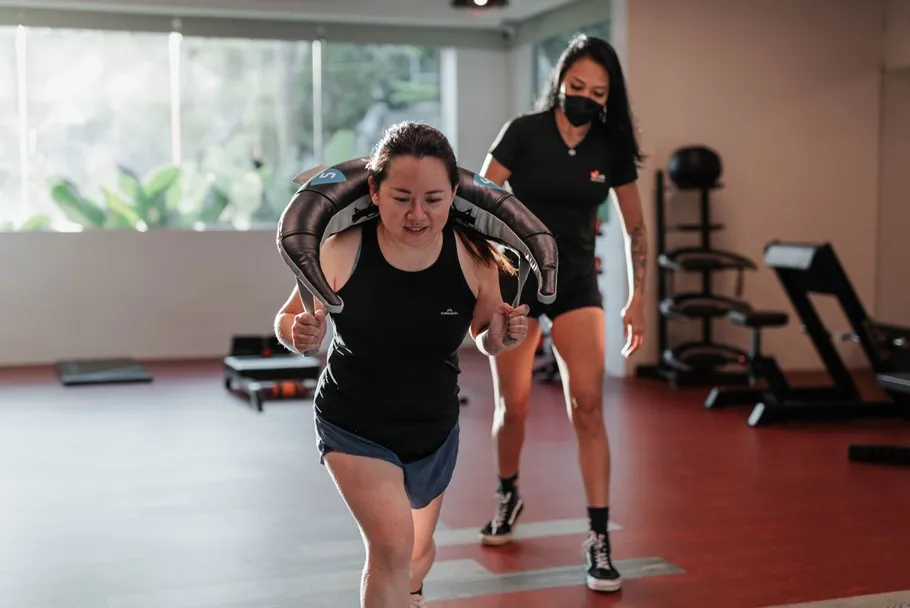
Photo: TSquared Lab, Pexels — Two women strength training in a Singapore gym with a personal trainer, an honest gym scene, not a product shot.
Will a weighted vest help me lose weight or fix my back pain?
No. A weighted vest adds load to walking, rucking and bodyweight work; it does not treat or cure back pain, shoulder pain, knee pain or any joint condition, and no pick in this guide claims otherwise.
A vest lets you carry more load on a walk, so the muscles and heart work harder — but that help is for the walk, not a promise about weight or pain, and a vest is not a treatment.
Persistent pain, numbness, weakness, or a recent injury belongs with a clinician first — a vest is not a diagnosis, and training through sharp pain to test one is a bad idea.
How heavy should my first weighted vest be?
Start at 10–20 lb. The Hyperwear arrives pre-loaded at 10 lb and the VEVOR loads from 11 to 20 lb, so either one is a sensible first vest.
So the listing you order from is the authority on load, not any size chart — vests are sold by size, version or option, not by body weight. And the Kensui Lite at 80 lb is not a first vest for most buyers.
Can I run in a weighted vest?
Yes, with a fitted vest. The Hyperwear is the closest fit here, and a vest that stays put is the one to run in — a loose vest bounces on every stride.
Start with walking, keep the first runs short, and stop on knee or ankle pain. A vest adds load to every step, so the joints feel it before the muscles do.
Do I need to buy plates separately?
It depends on the pick. The 5.11, Kensui and GORUCK all need plates bought separately — the 5.11 takes 5.11 or Rogue plates, the Kensui takes your own Olympic plates, and the GORUCK takes Curved Ruck Plates.
The Hyperwear arrives pre-loaded at 10 lb, the VEVOR ships with its six 1.5 lb bags, and the Titan ships with its 2.5 lb ingots. So check what is in the box before the first walk.
Plate carrier or fitted vest — which should I choose?
A plate carrier suits heavy loads and plate swaps — the 5.11 takes 5.11 or Rogue plates, and the Kensui frame takes your own Olympic plates up to a stated 300 lb.
A fitted vest suits running and a close fit — the Hyperwear is the closest fit here, with micro-weights that barely move. So choose a carrier for heavy loads and a fitted vest for running.
How do I wash a weighted vest, and how do I look after it?
Remove the weights first. The Titan is hand wash only with the ingots out, and the same rule holds for every vest here — weights out, hand wash, air dry.
Keep vests dry, wash them as the maker directs, and store them flat or hung — never folded hard. And pair loaded work with gentle mobility, since our foam rollers guide covers the recovery side of a home-gym routine.
Thanks for reading — we hope this guide helps you pick a weighted vest that spreads the load and does the job you actually need. If a load or a model name disagrees with what you measured, trust the listing, not the headline.
Disclosure: As an Amazon Associate, we earn from qualifying purchases made through links in this article, at no extra cost to you. Product details and availability can change, so please check the listing before ordering.
Pingback: Best Jump Ropes for Home Gyms (2026)