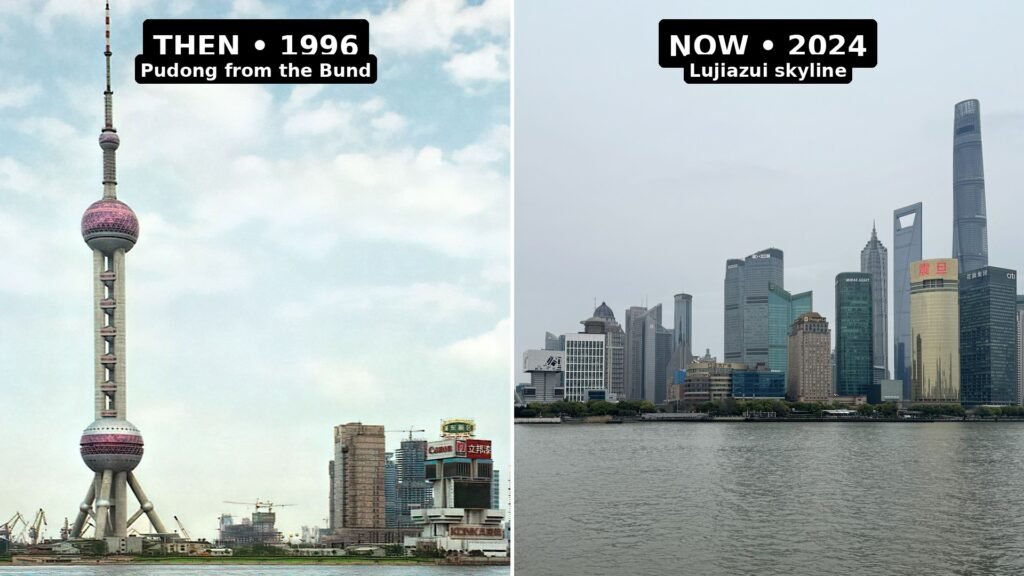
Stand on the Bund in 1996 and look east. You see the Oriental Pearl Tower standing almost alone. Behind it: low buildings, construction sites, and empty land.
Stand in the same spot today. You see a forest of skyscrapers. That is the whole story of Shanghai. Same river. Same viewpoint. A different world. 🌏
Shanghai Then 🏙️

Shanghai began as a fishing village called Hu. Its name means “On the Sea.” By the 1200s, it was a county seat. By the 1700s, it was a cotton town.
Then came 1842. After the First Opium War, the Treaty of Nanjing opened Shanghai to foreign trade. Britain, France, and America built concessions along the Bund.
The Bund became China’s Wall Street. Grand banks. Trading houses. Hotels. Foreign money poured in. Shanghai became China’s biggest port and its most glamorous city.
But it also became a divided city. Foreigners lived under their own laws. Chinese workers did the hard labour. The 1920s brought protests, boycotts, and revolution. The Communist Party was founded in Shanghai in 1921.
War followed. Japan occupied Shanghai from 1937 to 1945. Industry was shattered. Then civil war. In 1949, the People’s Liberation Army took control. A new era began.
For decades after 1949, Shanghai grew slowly. National policy favoured inland cities. Shanghai stayed important, but it stopped racing ahead.
By 1980, the city looked frozen in time. The Bund’s old banks were still there. Across the river, Pudong was farmland. Vegetable plots. Small houses. Narrow roads. A ferry to cross the river.
Locals joked that a bed in Puxi — the old west side — was worth more than a whole room in Pudong. Nobody wanted to live across the river.
The Middle: Farmland Becomes a Skyline 👑
Everything changed in 1990. Beijing chose Pudong as the test ground for China’s economic opening. In 1993, Pudong New Area was officially founded.
The plan was bold. Turn fields into a financial district. Build a Chinese answer to Lower Manhattan. Many people thought it was impossible.
Then the towers started rising. One by one, they rewrote the skyline.
The Oriental Pearl Tower came first. Completed in 1994, it was 468 metres tall. It was the tallest structure in China at the time. Its pink spheres looked like something from the future.
Next came Jin Mao Tower. Completed in 1999, it rose 421 metres. It looked like a stepped pagoda made of glass and steel.
Then the Shanghai World Financial Center. Opened in 2008, it stood 492 metres. Locals call it “the bottle opener” because of the hole at its top.
Then the tallest of them all. Shanghai Tower, completed in 2015, twists 632 metres into the sky. It is China’s tallest building and the second-tallest in the world.
In just 25 years, Pudong went from fields to more than 100 skyscrapers. No city in history has changed its skyline that fast.
The 2010 World Expo showed the new Shanghai to the world. From May to October 2010, over 73 million people visited. It was the largest Expo ever held. The theme was “Better City, Better Life.”
Transport changed just as fast. Shanghai’s first metro line opened in 1993. Today the network stretches over 800 km with more than 500 stations. It is one of the longest metro systems on Earth.
In 2004, the Shanghai Maglev started running. It floats on magnets and hits 431 km/h. It covers the 30 km from Longyang Road to Pudong Airport in about 8 minutes. It was the world’s fastest commercial train.
People poured in too. The municipality counted 13.3 million people in the 1990 census. By 2000, it was 16.4 million. By 2010, it was 23.0 million. By 2020, it was 24.9 million.
Like Singapore, Shanghai turned a port into a global hub. Like Dubai, it built a skyline from almost nothing in a single generation.
Shanghai Now 📈
Today, Shanghai is China’s biggest city and one of the world’s great cities. Around 25 million people live in the municipality. Its urban area is the most populous in China.
The skyline tells the story. Lujiazui holds the Shanghai Tower, the World Financial Center, Jin Mao Tower, and the Oriental Pearl Tower — all within a few minutes’ walk of each other.
Shanghai is a global financial centre. The Shanghai Stock Exchange sits in Pudong. Hundreds of banks and financial firms have offices in Lujiazui. The city ranks among the world’s top financial hubs.
The Port of Shanghai is the world’s busiest container port. Goods from across China leave through Shanghai for every continent. The city is still what it always was: China’s gateway to the world.
But old Shanghai is still there. The Bund’s colonial banks still line the river. Yu Garden still has its pavilions and ponds. The French Concession still has its tree-lined streets and Art Deco houses.
That mix is what makes Shanghai special. A 1920s bank across the river from a 632-metre tower. A dumpling stall under a skyscraper. A temple next to a metro station.
From a fishing village to a treaty port. From farmland to a forest of towers. From 4 million people to 25 million.
No city on Earth has changed this much, this fast. And the skyline is still growing. 💪
FAQ ❓
How has Shanghai changed?
In 1990, Pudong was farmland with no skyscrapers. Today it holds more than 100 skyscrapers, including China’s tallest building. The population roughly doubled, the metro went from one line to over 800 km, and Shanghai became a global financial centre.
What did Shanghai look like in 1980?
In 1980, Shanghai was a low-rise port city. The Bund’s old banks dominated the waterfront. Across the Huangpu River, Pudong was fields, warehouses, and small houses. There was no metro, no Maglev, and no skyscraper skyline.
What did Shanghai look like 50 years ago?
Fifty years ago, in the mid-1970s, Shanghai was a slow-growing industrial city of a few million people in its urban core. The skyline was flat. The transformation had not started yet — Pudong’s boom began in the 1990s.
What did Shanghai look like in 1950 vs now?
In 1950, Shanghai’s urban area held about 4.3 million people, and the city was recovering from war. Today it holds around 25 million. In 1950, there were no skyscrapers, no metro, and no Pudong skyline. Now all three define the city.
What is Shanghai’s population now?
Around 25 million people live in the Shanghai municipality (24.9 million in the 2020 census). It is China’s most populous city and one of the largest cities in the world.
Why is Shanghai called “Demon City”?
Shanghai is sometimes called “Demon City” because of its early-20th-century reputation for the opium trade, crime, and nightlife. The nickname comes from the city’s wild years as a treaty port.
Pingback: Bangkok Then and Now